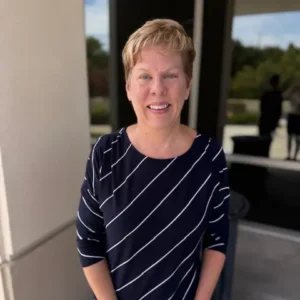
For someone living with dementia, environment isn't just important, it's everything. Kristin Cherry, Family Advisor at Story Cottage, explains why large memory care communities often feel wrong to families, and how a calm, home-like setting changes the way a person experiences their day.
What is the current reality of dementia care?
The current reality of dementia care is that more families than ever are navigating a dementia diagnosis. And often, the first place they turn is a very large memory care community, or a memory care wing attached behind a wall inside a larger building.
For many families, that's where the search starts. But it's rarely where the right answer is.
Why does what families feel on a tour matter so much?
What we hear over and over again from families touring those settings is the same thing:
"This doesn't feel right."
"The staffing ratios aren't right."
"It's too busy."
"It's too overwhelming."
"It's too unfamiliar."
That gut reaction matters. Families are often picking up on something their loved one would feel ten times more strongly. For someone living with dementia, environment isn't just important. It really is everything.
Why is environment everything for someone living with dementia?
Dementia changes how someone processes the world around them. The brain has to work harder to filter, interpret, and respond to ordinary sensory input, and certain environments make that work nearly impossible.
Things that often feel routine to us can be deeply disorienting for someone with dementia:
Large, open spaces that feel unfamiliar and hard to navigate
Loud noises from intercoms, alarms, and bustling hallways
Call lights going off constantly throughout the day and night
Rotating staff who don't know the person's history, preferences, or cues
Why does feeling safe matter beyond physical safety?
At Story Cottage, we see how powerful the right environment is when someone feels safe, not just physically, but emotionally.
Physical safety is the baseline. Emotional safety is what allows a person to actually live their day. When someone with dementia feels emotionally safe, you see real changes:
Less agitation and fewer anxious moments
Better sleep and more predictable routines
More willingness to eat, engage, and participate
Glimpses of their personality coming back through
That's not a luxury. That's the point of memory care. And it's hard to deliver in a setting that feels like a hospital.
What's different about the Story Cottage boutique model?
Our boutique model is built around exactly this principle. Each Story Cottage is intentionally small, just 8 to 10 residents, so the environment can stay calm, familiar, and personalized.
That means:
A consistent, dedicated team who knows each resident
A 4:1 resident-to-caregiver ratio that's almost unheard of in larger communities
A real home, in a real neighborhood, not a wing attached to something bigger
"For someone living with dementia, environment isn't just important. It really is everything."
— Kristin Cherry, Story Cottage
Frequently Asked Questions
Why does environment matter so much in dementia care?
Dementia changes how a person processes their surroundings. Large spaces, loud noises, call lights, and rotating staff can overwhelm the brain and trigger confusion and anxiety. A calm, familiar, home-like environment reduces that load and helps the person feel safer and more themselves.
What's wrong with large memory care communities?
There's nothing inherently wrong with them, but for many people living with dementia, the scale, noise, and constant staff turnover create exactly the kind of stimulation their brain struggles to filter. Families often describe these settings as too busy or too overwhelming on a tour.
What does a home-like environment actually mean?
At Story Cottage, it means a real residential home with 8 to 10 residents, consistent caregivers, quiet daily rhythms, familiar living spaces, and a layout that looks and feels like a home, not a hallway in a facility.
Why is emotional safety important for someone with dementia?
Physical safety keeps a person from harm. Emotional safety lets them actually live their day. When someone feels emotionally safe, agitation drops, sleep improves, and personality often comes back through, which makes everything from meals to family visits easier.
What is the staff-to-resident ratio at Story Cottage?
Story Cottage maintains a 4:1 resident-to-caregiver ratio, which is among the lowest in the Indianapolis area and a key part of how the home-like environment stays calm and personalized.
Where are Story Cottage homes located?
Story Cottage has memory care homes in Indianapolis and Carmel, Indiana, including Williams Creek, Carey Grove, West Clay, Meridian Hills, and Woodland.
Kristin Cherry
About the Author
Kristin has over 30 years of experience in Independent Living, Assisted Living, and Memory Care, with advanced degrees in Gerontology, Family Services, and Counseling. She has held leadership roles including Executive Director, Regional Sales Manager, Divisional Sales Manager, and VP of Sales and Marketing for several large companies. Kristin is also a recognized speaker on senior care topics, presenting throughout the Midwest on Alzheimer’s Disease, Assisted Living vs. Nursing Homes, and Memory Care Programs.
She has received multiple awards, including the BGSU Gerontology Program Partnership Award and the Resident Director Best Practices Award, and has been recognized locally for her leadership in team development. Kristin is also President of the Indiana Kappa Delta Alumnae Association and actively consults with alumnae navigating senior care options for their loved ones.
Outside of work, Kristin and her husband, Dave, who have been married 33 years are dedicated Great Dane Rescue fosters, having fostered and placed nine dogs into loving homes. Kristin has a daughter, who just got married and works at Purdue. Follow her on LinkedIn.